This summer, the SMSG team has been pleased to be joined by Hino Tanaka, who is based at Middlebury College, Vermont. He is working in the lab of Dr. Alexis Mychajliw and concentrating on Japanese small mammals. Hear from Hino about his research assistant placement here:
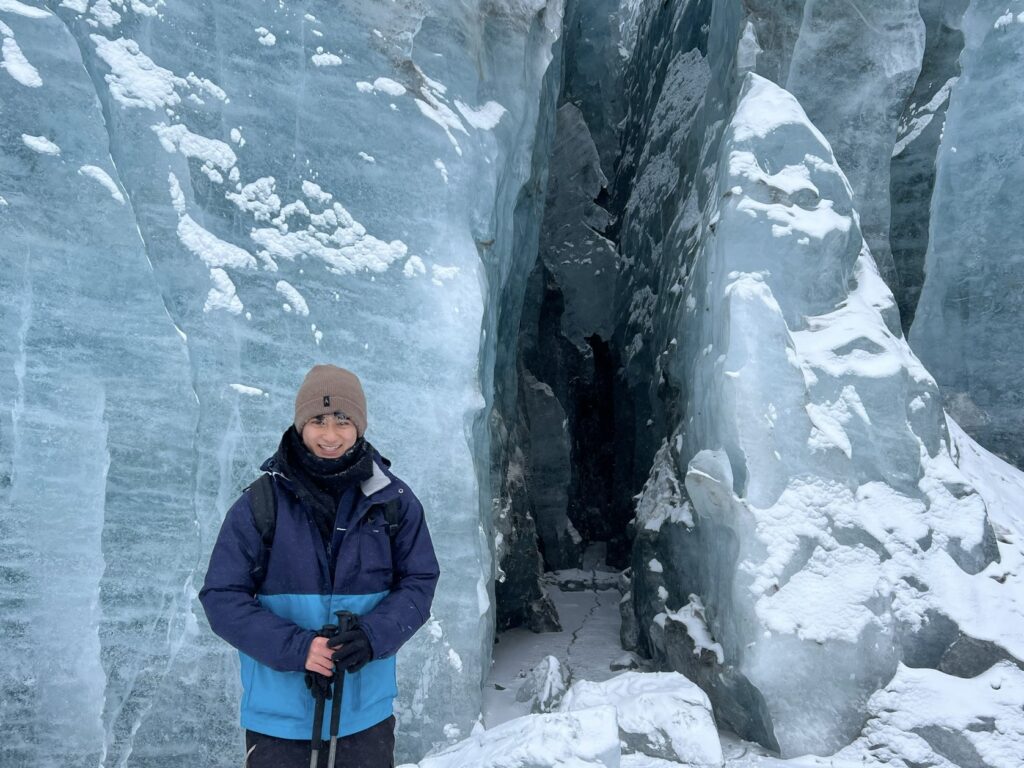
Hino during a trip to Greenland
“I study Geography at Middlebury College, where I use GIS and cartography to explore questions of visibility: how maps make overlooked landscapes, species, and histories visible. My advisor, Professor Jeff Howarth, has deeply shaped my approach to mapping, spatial analysis, and interdisciplinary geography. Building on these interests, I am working this summer as a research assistant with Professor Alexis Mychajliw, who connected me with Dr. Ros Kennerley and the Small Mammal Specialist Group to contribute to IUCN Red List reassessments for small mammal species endemic to Japan.
So far, I have started with Japanese shrews, including the Shinto shrew and Azumi shrew. I review scientific literature in both English and Japanese, prepare reassessment drafts, and create distribution maps using occurrence and elevation data. I have really enjoyed seeing how the Red List process brings together taxonomy, ecology, spatial data, and careful scientific communication.
This theme of visibility also shapes my broader cartographic work on colonial history, environmental change, and representation. Previous projects have examined land use and colonial legacies in Okinawa, as well as historical land-use change in Hokkaido. My undergraduate thesis focuses on Ainu place names in Hokkaido, using cultural cartography and toponymy to examine Indigenous cultural and linguistic persistence under Japanese colonialism.
Looking ahead, I hope to keep working at the intersection of GIS, data analysis, visualization, and design, especially on projects that make complex or underrepresented issues easier to see. Working with the SMSG has been an exciting opportunity to apply those interests to global conservation, and to help make Japan’s small mammals more visible in conservation assessments.“